1P00CZ84: Pedagogical Competence II (Teaching Practice)

Updated: Feb 10
Course requirements:
Objective of the course:
The student will first create a development task and its intended learning outcomes and then plan the methods to obtain and display the competence defined by the learning outcomes.
Accomplishment methods on
You can acquire competence related to the development task, for example
- by participating in development work in your field of study
- by working in development projects in vocational education operating environments
- by becoming familiar with the learning guidance and pedagogical models implemented in vocational education's working life networks
- guiding the student as a workplace supervisor/educational institution supervisor in the environments of learning or training that takes place in working life
- by participating in the development of the vocational teacher education curriculum
19. You plan a learning module in your own substance field.
Did you also teach this course? If yes, have you got recordings of your teaching?
Also, the guidance / supervision of student projects fits clearly into Teaching practice competence goals:
Yes, I have taught only one 4-hour contact session of this course because it gave me a good opportunity to meet students and introduce them to aspects that interest me as a subject. The recording of this has been deleted from the server since then, but the experience remains really good to teach. In this session, I aimed at making active learning whereby the students conceptualized the idea and gave applicative concepts. While the lack of a recording limits concrete evidence, my reflection of the session and the results seen in student participation and feedback demonstrate the effectiveness of my teaching.
Example: Teaching course slides: UVA Course slides
Besides the teaching session, I was a students' project supervisor, which is considered close to the competence goals of teaching practices. In other words, it meant guiding a student through different stages of his work: from the formulation of objectives to the refinement of methodologies for analyzing the outcomes. This included providing regular feedback and fostering critical thinking as part of their academic development and independent learning skills. The double role of teacher and project supervisor brought into view my capability for effective mentoring, fostering active learning, and contributing to professional growth, which are all part of teaching practice competence.
Example: Evaluation and Feedback: Evaluation and Feedback
20. You will execute a learning module in your own substance field according to the implementation plan prepared by you.
Recently, I led a learning module in the subject area of substance. In this teaching practice, everything was done precisely according to the detailed implementation plan made earlier. This focused the students on active learning. For example, at the University of Vaasa during my delivery of the module "Internationalization of Sustainable Entrepreneurship," I integrated various types of teaching methods: case-based learning, debates, and simulations. These approaches catered to different learning preferences and helped bridge the gap between theoretical concepts and practical applications. The module was structured to foster critical thinking and collaboration, ensuring that students were actively involved in their learning process.
Implementing this module, I also sought to integrate industrially relevant applications to add flavor to learning. Drawing on the other curriculum development work of re-designing the undergraduate entrepreneurship course at Notre Dame University, Bangladesh, I have produced full workshop materials with activities promoting critical evaluation and application of knowledge. I use formative assessments and interactive workshops as a means of monitoring student achievement to identify areas for my own professional development. This active and reflective process ensured the module did not only meet the learning objectives but also facilitated the broader development of academic and professional skills in its students.
Examples:
Lesson plans: Updated Syllabus_GMM2022 24 March.pdf
Screenshots of course Moodle

Description of guiding process: DESCRIPTION OF GUIDING PROCESS.pdf
Description of assessment methods used:
Assessment methods
· Launch assignment 50% (20% presentation, 20% plan, 10% interaction through “discussion forum” and thoroughness of “peer-evaluation” of another group)
· Exam 50%
· Rating of course: 1-5 / failed (to pass the course minimum 40% of total points is required
21. You evaluate and provide feedback on learning, competence and professional growth.
In addition to academic assessments, competence and professional development are the emphases I try to bring forward. Supervising bachelor's and master's theses both at the University of Vaasa and Notre Dame University Bangladesh allowed me to encourage students to reflect upon their learning journey and further connect their knowledge in practical contexts. For instance, I led students in preparing research projects related to current, practical issues. These provided them with further experience within their specific area and professional roles that may have been expected. In the usual process, I conduct feedback discussions touching on points related to their future aspirations, soft skill enhancement, and matching course outcomes to professional world requirements. At the end, students can also gain further professional competence aside from pure theoretical knowledge from the course.
See the attached files:
INDEPENDENT WORK FOR COMPETENCE FOR RECOGNITION
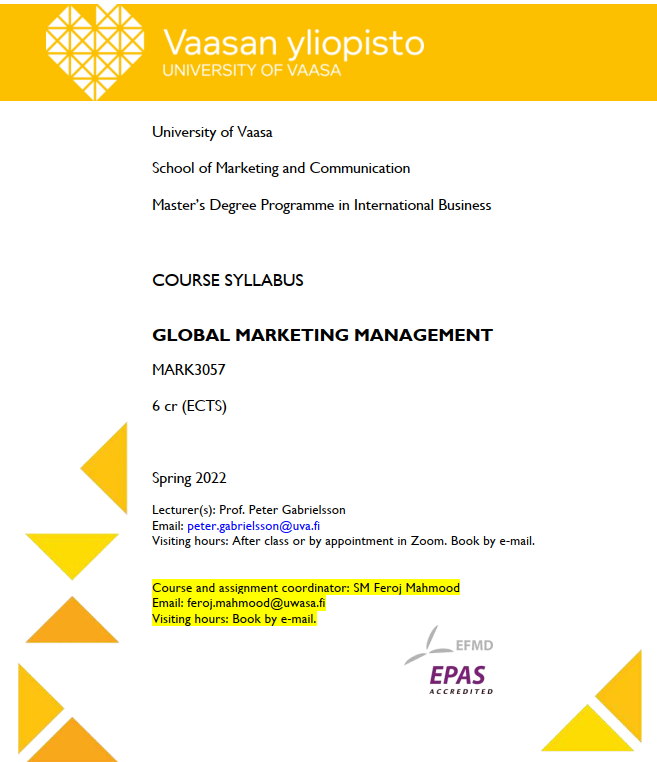
As the course coordinator of a Global Marketing Management Master's Level course, I worked extensively in the development of my field. The development tasks called for a combination of academic planning and pedagogical and managing abilities so that the course objectives would be met and students would have a good, proper learning process. This was the role which kept me constantly coordinating with the instructors and students, as well as stakeholders outside the academy, in regard to meeting academic standards and needs for worldwide marketing practice.
I was supposed to develop the class curriculum and syllabus. I designed this class to effectively interweave the theoretical underpinnings with practical applications effectively so that students would be capable of applying knowledge to on-the-job, actual marketing challenges. The syllabus comprised global market entry strategy, cross-cultural consumer behavior, and digital marketing trends all packaged to meet the expectations of master's level education. I further enhanced learning by integrating case studies from renowned sources such as the Harvard Business Review and adding to these some market reports reflective of current global trends. I have added, for example, a module where students had to analyze problems regarding the extension of Finnish company operations to Asian markets. In such a way, the students could apply theoretical concepts and critical thinking.
A very important aspect of my job was also related to collaboration with the teaching staff. I organized the work of a team of instructors and guest lecturers, assuring unified delivery of course content and its correspondence to the syllabus. I mentored the instructors to conduct experiential learning approaches, such as group projects or role-playing exercises, which they will find particularly helpful in learning complex decision-making in global marketing. I invited guest speakers from multinational corporations who could share practical perspectives to enhance the course. For instance, I organized a lecture from a senior marketing executive of a Nordic company, where he presented how they handle cultural subtlety while marketing their products in emerging economies. Such interactions reduced the gap between academic learning and the practices of the industry.
Considering Finland's priority for sustainability and ethics, I have kept them in mind to ensure the course covers these critical themes. I adapted the content on sustainable marketing, showing how organizations incorporate environmental responsibility into their strategies. Then, I suggested case studies related to ethical dilemmas of marketing campaigns on cultural sensitivity, inclusivity, and corporate social responsibility. For example, I added a paragraph about Finland's global leading role in fostering sustainability in industries such as forestry and technology. In inviting thoughts on the interplay between marketing and ethical behavior, I hoped to foster critical thinking.
Supervising student projects was another central part of my job. I guided students through projects such as developing a global marketing plan for a Finnish start-up looking to enter new markets. I regularly provided feedback which would help students align their projects with academic expectations while solving real-world challenges. I have also encouraged collaboration within diverse teams, emulating the complexity of international business environments. Final presentations were also evaluated by industry professionals, thus allowing students to experience real-life pitching scenarios and to receive constructive feedback from practitioners.
A very important aspect of my role was assessment design. I developed, along with the team, the criteria for evaluation that would balance rigor in subsidy with practical application, providing students with opportunities to demonstrate knowledge and show achievements. The assessment methods involved individual projects, group presentations, and reflective essays-all of these were to promote critical thinking and independent learning. For instance, I performed peer review activities, in which students evaluated the work of their classmates to increase collaborative learning and responsibility for others.

Following professional competencies were acquired during this role: The strategic plan and management involved in a complex course added value to my organizational and leadership skills. Working together with various stakeholders, including teachers and business practitioners, enhanced my teamwork and communication skills. In addition, the use of novel pedagogies developed my specific pedagogical competencies, in particular, about how to tailor education for the master's level student.
Course coordinator experience also meets Finland's educational values in the emphasis on student-centered approach, sustainability, and internationalization. I therefore had to focus on active learning and critical thinking to adequately arm them for the challenges awaiting them in careers in global marketing. The course also reflected the emphasis on ethical and sustainable practices that Finland attaches to courses, very important concerns in today's global business environment.
In all, my work as a coordinator of the Global Marketing Management course is a perfect example to explore whether development work stimulates professional growth and provides relevant contributions to both vocational and academic education. This experience not only provided the opportunity to improve the learning environment for students, but also helped me lay a sound foundation of skills and knowledge considered crucial for success in the education field.


Comments